Trick-or-Treat With a Dog: How to Not Terrify Your Pup
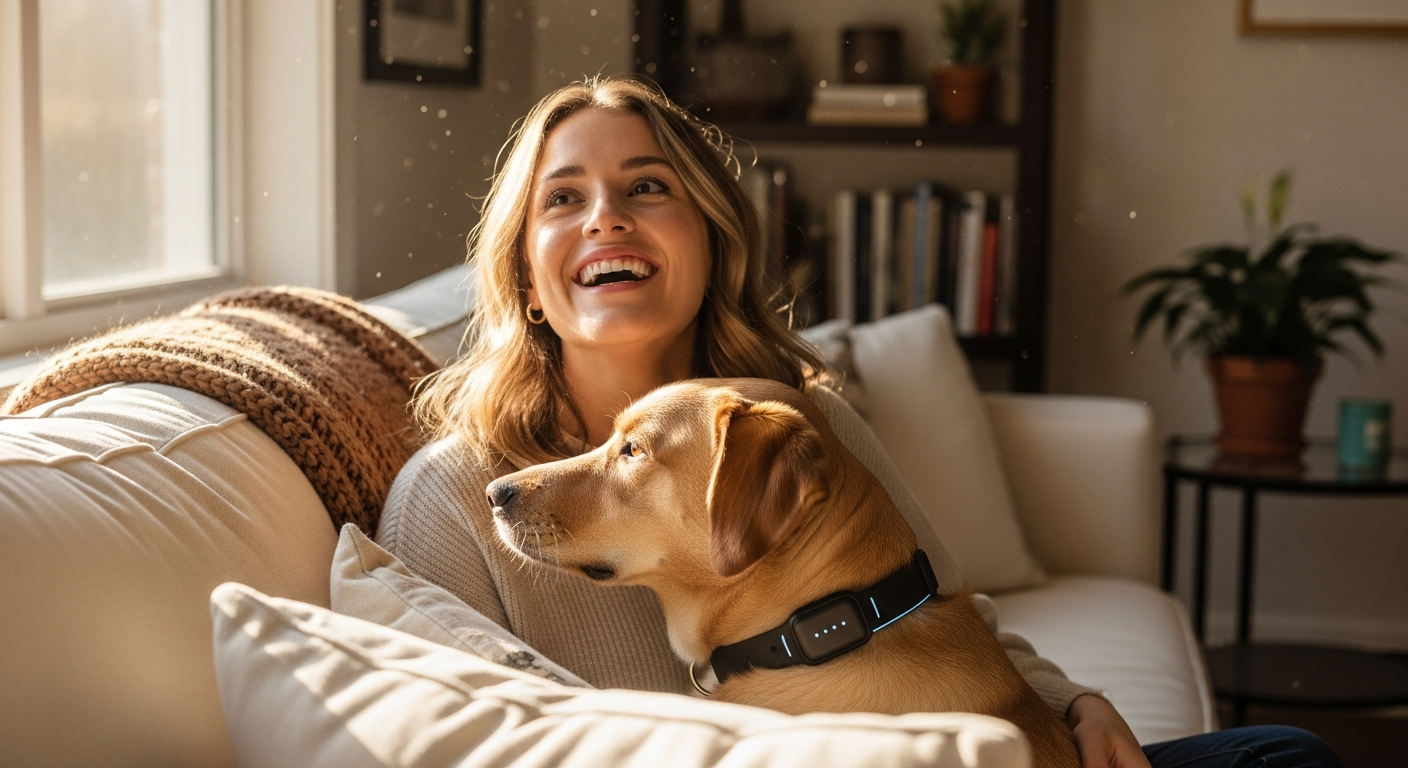
Keep a dog calm during trick-or-treating by doing the hard work early: desensitize them to the doorbell and a costume over the one to two weeks before Halloween, manage the front door instead of opening it for every knock, and give them a quiet back room with familiar bedding once the night actually starts. Most Halloween dog anxiety comes from repeated, unpredictable noise and strangers at the door — not the holiday itself.
Key takeaways
- Start doorbell and costume desensitizing one to two weeks before Halloween, in short sessions paired with treats.
- Watch for stress signals — tucked tail, pinned-back ears, panting, pacing, "whale eye" — and back off when you see them.
- A back room with a closed door and white noise is a legitimate plan for a stranger-wary dog, not a consolation prize.
- Chocolate and xylitol in candy are real, verified dangers — keep bowls and trick-or-treat bags out of reach.
- Give kids an actual job (handing out treats, sitting with the dog, running practice sessions) instead of just telling them to "be careful."
Why is my dog scared of Halloween?
It's rarely the holiday itself — it's the doorbell ringing over and over, strangers in masks and costumes that hide the body language dogs normally read, and hours of noise crammed into one evening. A dog who's relaxed around normal visitors can still unravel when the same startling event repeats every few minutes for two hours straight.
Watch for the early signs instead of waiting for barking or hiding. According to the AKC, stressed dogs often show a tucked tail, ears pinned back, pacing, shaking, lip licking, or "whale eye" (showing the whites of their eyes) well before they escalate to barking or bolting. Catching these early means you can remove your dog from the situation before it gets worse, instead of after.
How do I desensitize my dog to the doorbell before Halloween?
Start now, not on October 31st. Play a doorbell sound (a video works fine) at a volume low enough that your dog barely reacts, and feed treats the moment it rings. Over several short daily sessions, raise the volume and the number of rings only after your dog stays relaxed at the current level — if they freeze, won't take a treat, or try to leave, you went up too fast and need to drop back a step.
This is the same gradual-exposure-plus-reward principle the AKC recommends for easing dogs into Halloween decorations: start where your dog is comfortable, and move closer only once they're calm there. Two weeks of five-minute sessions beats one panicked cram session the night before, but even three or four days helps.
Should I use a costume on an anxious dog?
Only if your dog is already neutral-to-happy about wearing things, and only after a trial run well before the 31st. The AVMA specifically recommends getting your pet accustomed to a costume ahead of time rather than putting it on for the first time on Halloween night, and never leaving a costumed dog unsupervised.
Introduce costume pieces one at a time — a bandana first, then a simple layer — rewarding calm behavior at each stage. Before committing to a full costume, the AKC's costume safety guidance is worth a quick read: check that nothing restricts breathing, vision, hearing, or movement, that there are no small chewable parts, and that your dog can still pant and drink normally. If your dog is already anxious about Halloween in general, skip the costume this year and remove one more thing they have to cope with.
What about strangers in costumes and masks?
Masks, hoods, and face paint cover up the facial expressions and posture dogs normally rely on to size up a person, which is part of why even friendly, social dogs can act unsure of costumed trick-or-treaters. A kid your dog has met a dozen times can suddenly look like a stranger in a full-face mask.
If your dog is generally fine with visitors, you can help by greeting trick-or-treaters outside on the porch instead of opening the door, which removes the "stranger rushing into the house" trigger entirely. If your dog tends to be wary of new people even without costumes involved, plan now to keep them in another room for the evening rather than testing it live on Halloween.
Is Halloween candy actually dangerous for dogs?
Yes — this isn't exaggerated pet-parent folklore. Chocolate, especially dark and baking chocolate, can cause vomiting, a racing heart, and in serious cases seizures. The ASPCA warns that xylitol, found in many sugar-free candies and gums, can cause a dangerous blood sugar crash and liver damage even in small amounts. The AVMA also flags raisins, sometimes mixed into trick-or-treat bowls, as a kidney-failure risk.
Keep the candy bowl up high, empty trick-or-treat bags into a cabinet the moment kids get home, and check the floor by the front door for dropped wrappers. If your dog eats anything containing chocolate or xylitol, call your vet or the ASPCA Animal Poison Control Center right away rather than waiting for symptoms.
When should I just put my dog in a back room instead?
As soon as you know trick-or-treating isn't going to be fun for your dog — and that's a completely fine call to make ahead of time, not a last resort. The AVMA directly recommends keeping a pet who is wary of strangers in a separate room away from the front door during trick-or-treating, rather than managing them at the door all night.
Set the room up before the first doorbell rings: water, a favorite chew, familiar bedding, and a fan or TV to blur out the knocking. Some dogs do better with company; others settle faster left alone with a chew. Don't feel obligated to "include" an anxious dog in trick-or-treating just because it feels like the family thing to do.
How can my kids help keep the dog calm on Halloween night?
Give kids a specific, age-appropriate job instead of a vague instruction to "be careful with the dog." Kids 3–5 can sit quietly with the dog in the back room or help choose their chew toy for the night. Kids 6–9 can help run doorbell-sound practice sessions in the weeks before Halloween, handing out treats on cue. Kids 10–13 can take over the whole doorbell-training routine, manage the back-room setup on the night itself, or help plan a calmer front-porch greeting instead of opening the door.
One safety note that matters regardless of age: always supervise kids around a stressed, overstimulated, or costumed dog. Even a normally gentle dog can nip when overwhelmed with nowhere to go, so don't leave young kids alone with the dog during the doorbell rush, and teach older kids the stress signals from the first section before they go in for a hug. The complete guide to kids and dogs covers supervision basics well beyond Halloween night. And if your family already does seasonal photo traditions, a calm, no-costume Halloween picture is a fine stand-in — see 10 family dog traditions worth starting for ideas that don't require a costume at all.
What if my dog is scared during trick-or-treating itself?
If your dog is already showing stress signals mid-evening, stop trying to "push through it" and move them to the back room setup immediately — don't wait for the doorbell marathon to end on its own. A leash on your dog even indoors, away from the door, gives you a quick way to redirect them without a chase.
Don't force your dog to greet costumed visitors, don't let kids drag a reluctant dog over for photos, and skip correction-based "calm down" commands, which tend to add pressure rather than relieve it. Reward calm behavior generously wherever it shows up, even if that's just lying down in the next room. For low-key activities that work fine in a closed-off room while the doorbell keeps ringing, try these indoor dog games for kids.
For dogs who handle the chaos just fine, Halloween can also be the fun night families remember later — a funny, in-on-the-joke "voice" for the dog during costume photos is the kind of entertainment a talking collar like SPEAK ($199 Founder's Edition plus $5/month) is built for, not a way to learn what your dog is actually thinking, but a bit the whole family can laugh at, in the same spirit as imagining what your dog would say on an ordinary day. If your dog is the anxious one this year, skip that and focus on getting them through the night calm — there's always next Halloween.